Would you like to change your language?
Please choose your language:
G’day. Would you like to change location?
It looks like you are outside Australia. Select a flag below or click “ignore” if you are happy with the Australian version.


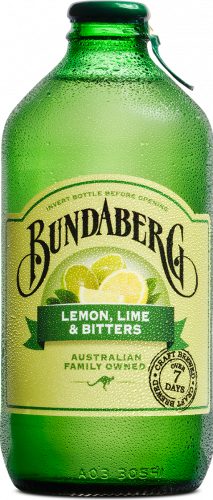
Order a lemon, lime and bitters anywhere in Australia, from a surf club on the coast to a pub a long way inland, and nobody asks you to explain yourself. LLB is the drink you have when you’re driving. It’s the drink at the nineteenth hole, the one you order when everyone else is on beers and you’d rather not be.
It has held that position for decades without much fuss. Here’s what actually goes into it, where it came from, and how Bundaberg Brewed Drinks brews a version that doesn’t need a bartender standing over it.
Three components, as the name promises: lemon, lime and aromatic bitters. Made over a bar, it’s lemonade, a shot of lime cordial or fresh lime, and a few dashes of bitters, stirred through ice in a tall glass.
The bitters is the part that matters. It’s a small, aromatic hit of spice and botanical bitterness, and without it you’re just drinking lemon squash. Bartending reference Difford’s Guide files the drink under its initials and notes it is most popular in the country that invented it. It is genuinely local, enough so that it carries its own entry on Wikipedia, and it’s one of the few Australian bar staples to travel.
Bundaberg Lemon Lime & Bitters is craft brewed over seven days using real lemons and limes infused with aromatic herbs and spices. Our Master Brewer’s own bitters recipe goes in after that: cinnamon quills, clove buds and gentian root, added for the snap of bitterness that finishes the taste.
Gentian root is the traditional bittering botanical behind most aromatic bitters, and it is the reason the finish lands where it does rather than trailing off sweet. Seven days may seem like an unusual amount of time to spend brewing a soft drink, and How We Brew and Our Craft explain why our family has never shortened it. The same approach runs through the whole Traditional Brews range, from Ginger Beer to Sarsaparilla and Traditional Lemonade.
Invert the bottle before you open it. The sediment is natural and it belongs in the glass, not the bottom of the bottle
Pull the rip cap out to the side until it hisses, then up until it pops
Tall glass, filled with ice, not two cubes
A wedge of lime, squeezed and dropped in
Serve it cold. It is built as a thirst quencher
Sharp, citrus-forward and faintly bitter makes it a better food drink than most non-alcoholic drinks. It cuts through fat and salt the way a squeeze of lemon does, which is why it works next to fish and chips, salt and pepper squid, or anything off a grill. The Brewed Food collection has plenty to test that against, including Salmon with Pink Grapefruit Dressed Salad.
LLB is the base of a fair few drinks. Here’s a Bitta Lemon shakes lemon juice, strains it into a tall glass, tops it with Bundaberg Lemon Lime & Bitters and finishes with an orange wedge. The full Mixology collection runs past 100 cocktails and mocktails, and you can filter the whole list by Lemon Lime & Bitters to see every drink built on it.
Visit Shop Now to see online stockists with our partners across Australia, and if you’re near The Barrel in Bundaberg, you can order a case through Click and Collect and pick it up in store.
Not in any meaningful sense. Every Bundaberg brew carries minute residual traces of alcohol because the process uses natural yeast, and fermentation produces alcohol as a by-product. Before bottling, the brew is heated above 70 degrees to kill the yeast and stop fermentation, which leaves a residual level below 0.5%. That 0.5% figure is the legal threshold in Australia for labelling a drink non-alcoholic, set out in Food Standard 2.6.2 at Food Standards Australia New Zealand. Difford’s Guide lists Bundaberg Lemon Lime & Bitters at 0% alcohol by volume. Pub versions are a different matter, since traditional aromatic bitters are alcohol-based, though the quantity is tiny.
Bundaberg brews its own drinks, the Master Brewer’s recipe uses cinnamon quills, clove buds and gentian root. Full ingredient and nutrition panels for both the original and the Diet version sit on the Lemon Lime & Bitters product page.
A 375ml bottle of the original has 43.1g of sugar and 735kJ. The Diet version has 6g of sugar and 124kJ in the same size bottle.
Yes. Both Lemon, Lime & Bitters and Diet Lemon, Lime & Bitters are listed as vegan-suitable on the Bundaberg FAQs page, a classification made in consultation with ingredient suppliers. No animal testing is conducted on products or ingredients.
No caffeine. On gluten, no gluten is added to any Bundaberg brew, though some ingredients come from suppliers who handle gluten-based products, so cross-contamination cannot be ruled out entirely. The FAQs page sets out the full position.
Because it’s brewed rather than mixed. The sediment occurs naturally and varies slightly batch to batch with the seasonal ingredients. Inverting the bottle before opening redistributes it so the flavour is even from the first mouthful to the last.
Australia, and it remains most popular here. The drink’s Wikipedia entry covers the competing origin stories, most of which run through Australian pubs, golf clubs and surf clubs in the twentieth century. Bundaberg’s own story starts in 1968 and is set out on Our History.
Bundaberg brews reach more than 60 countries. Shop Now lists stockists by region, and the Contact Us page will get you to the team if your market isn’t covered.
For more on how the brews are made and what to do with them, have a wander through the Brewniverse, or join the Brew Crew and we’ll send the good stuff straight to you.